
Application
Ultrapure water (UPW) filtration, from the RO feed to the point of use.
Ultrapure water picks up something from every pipe, bed and filter it passes on the way to your process. Gopani filter cartridges and housings sit at each point of a UPW system, so the RO and EDI stay protected, resin stays in its vessel, and the water at the tool still meets its specification. Gopani supplies filter cartridges and housings to the ultrapure water plants of solar cell manufacturers in India.
- Pretreatment and ROA feed the RO membranes can take, and fewer cleans.Explore: Pretreatment and RO
- EDI and resin bedsThe EDI protected on the way in, resin fines held on the way out.Explore: EDI and resin beds
- Loop and point of useWater that holds its specification all the way to the tool.Explore: Loop and point of use
- Tank ventsRoom air and carbon dioxide kept out of the stored water.Explore: Tank vents
What is at stake
Water that adds nothing to the surface it touches.
Ultrapure water has its ions, organics, particles, bacteria and dissolved gases taken down to the limits the process using it sets. Each of them does its own damage when it gets through, and filtration controls some of them directly and protects the equipment that removes the rest.
- Particles
- A particle left on a wafer or a cell is a defect at that spot: a short, a mark in the texture, a place where a film will not hold. Filtration is the main control, at several points, because every part of the system can shed.
- Resin fines
- Fragments of ion exchange resin carry what the resin had taken up. Downstream they load the final filter early and can give ions back to the water.
- Bacteria
- Bacteria settle wherever water slows or stands: dead legs, tank walls, housings. They add particles while they live and organics when they die, and once a film forms on a surface it is hard to remove.
- TOC
- Total organic carbon leaves residues on surfaces and feeds bacterial growth. Everything the water passes can add some, a new filter included, which is why flush-up matters as much as retention.
- Ions and dissolved gases
- Ions lower resistivity, the figure most UPW plants run on, and dissolved carbon dioxide does the same. RO, EDI and resin remove ions, not filters, but a filter that leaches or a vent that lets air in can put them back.
The UPW system
Protect the water at every point, from the RO feed to the point of use.
Eight points in a typical UPW system where a filter cartridge sits, in the order the water meets them. Every UPW plant is built to its own train and its own specification, so an application engineer works through yours point by point.
- Point 1
Pretreatment and RO feed
Filter cartridges after the media and carbon filters take out the fines those beds release, so the RO membranes receive a feed within their limits. A feed that is not shows up as faster fouling, more cleans and earlier membrane replacement.Explore: Pretreatment and RO feed - Point 2
After the RO, ahead of the EDI
A filter on the permeate keeps debris from one stage out of the next, and out of an EDI stack that is slow and costly to clean. The line that cleans the RO and EDI in place is filtered too, so the solution does not carry back what it lifted.Enquire: After the RO, ahead of the EDI - Point 3
Resin trap after EDI or mixed beds
Ion exchange beds can release fines and broken beads, most of all after a resin change or a flow surge. A trap filter right after them keeps resin out of the storage tank and spares the final filter.Enquire: Resin trap after EDI or mixed beds - Point 4
Storage tank vent
The tank breathes every time its level changes. A dry hydrophobic vent filter keeps room air, dust and carbon dioxide out, so the water does not lose resistivity while it waits.Explore: Storage tank vent - Point 5
Polishing loop
Water circulates from the tank through UV and polishing resin and back, so it never stands still. A filter after the polishing bed keeps its fines from travelling round the loop with every pass.Enquire: Polishing loop - Point 6
Final filter
The last filter before distribution holds back particles and bacteria. It also has to flush up quickly to low TOC and full resistivity, so a filter change does not keep the loop out of specification.Explore: Final filter - Point 7
Point of use
A filter at the tool, bench or rinse tank inlet catches what valves, pumps and piping shed between the loop and the user. It is the last protection the process gets.Enquire: Point of use - Point 8
Reclaim and rinse water return
Rinse water and other lightly used streams can go back to the RO feed instead of the drain. Filtering them on the way protects the RO and lets the plant draw less raw water.Enquire: Reclaim and rinse water return
Swipe for all eight points
Process flow
Where filtration sits in a UPW plant, from the raw water to the tool and back.
A simplified view of a UPW system with the eight filtration points numbered as above. The arrangement in your plant is confirmed with an application engineer.
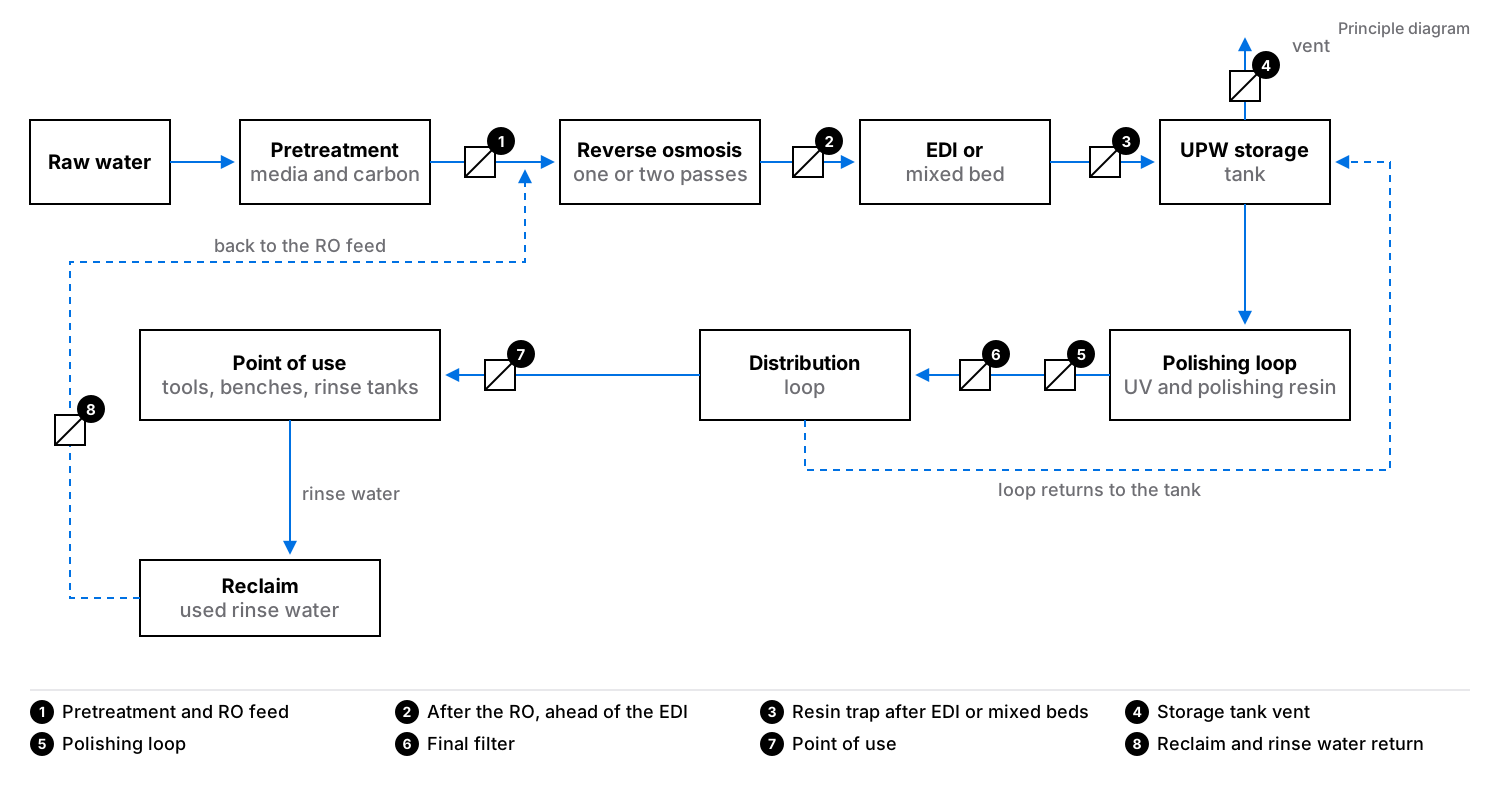
Swipe to see the whole flow.
Who runs it
The plants that run on ultrapure water, and what each one watches.
The points in the system are much the same from one industry to the next. What changes is the specification at the point of use and what a failure costs.
- Solar cell and PV manufacturing
- Every texturing, cleaning and rinsing step uses ultrapure water, in volumes large enough that rinse water recovery pays. Particles and metals left on the wafer become cell defects. This is the duty Gopani supplies today.Explore: Solar cell and PV manufacturing
- Semiconductor and electronics
- Wafer cleaning and rinsing run at the tightest particle, TOC and metals limits of any user, so filters are judged on what they release as much as on what they retain.Explore: Semiconductor and electronics
- Pharmaceutical water
- Pharma plants run purified water and WFI, which follow the pharmacopoeia rather than a UPW specification. The filtration points are of the same kind: a filter at the point of use and a dry vent filter on every tank.Explore: Pharmaceutical water
- Power plant make-up water
- Boilers take demineralised make-up water, and the condensate returned to them is polished before it goes back. Particles and corrosion products that get through end up as deposits on the boiler and the turbine.Explore: Power plant make-up water
Selection
What decides the filter at each point.
An application engineer asks for these before recommending a filter cartridge or a housing for any point in the system.
- Position in the system
- Pretreatment, RO permeate, after the resin, the loop or the point of use. The position sets what the filter has to hold back and what it must not add to the water.
- Water specification
- Resistivity, TOC, particle and bacteria limits at the point of use, and how and where each is measured.
- Flow and pressure
- Design and peak flow per housing, the pressure available across the filter, and how far the flow swings with demand.
- Start-up and sanitisation
- How long the system can run to drain after a filter change, and whether and how the loop is sanitised: hot water, ozone or chemicals.
- Materials
- Membrane, support, hardware and seals, and how each stands up to the water and to the sanitising method.
- Housing
- Stainless steel or plastic, the number of filter cartridges, the end fitting, and the connections and space already in the plant.
Troubleshooting
Common challenges
What each problem looks like on the line, what usually causes it, and the first two things to check.
Point 6, final filter
Likely causes
- A filter that releases extractables or ions when new
- Too little flushing before the filter is put on line
- Air trapped in the housing
Check first
- The flushing procedure and how long it runs
- The flush-up data of the filter against what you measure
What the right fix depends on
The filter and its flush-up data, the loop specification, the flow you can send to drain, and the start-up procedure you follow.
The Gopani filter for this duty:Clarypleat Nylon
Supplied
Filter cartridges and housings already at work in UPW plants in India.
Gopani supplies filter cartridges and housings to the ultrapure water plants of solar cell manufacturers in India: high flow filter cartridges ahead of the RO and the EDI and on the membrane cleaning line, pleated membrane filter cartridges after the polishers, and stainless steel housings on a skid.
Products for this application
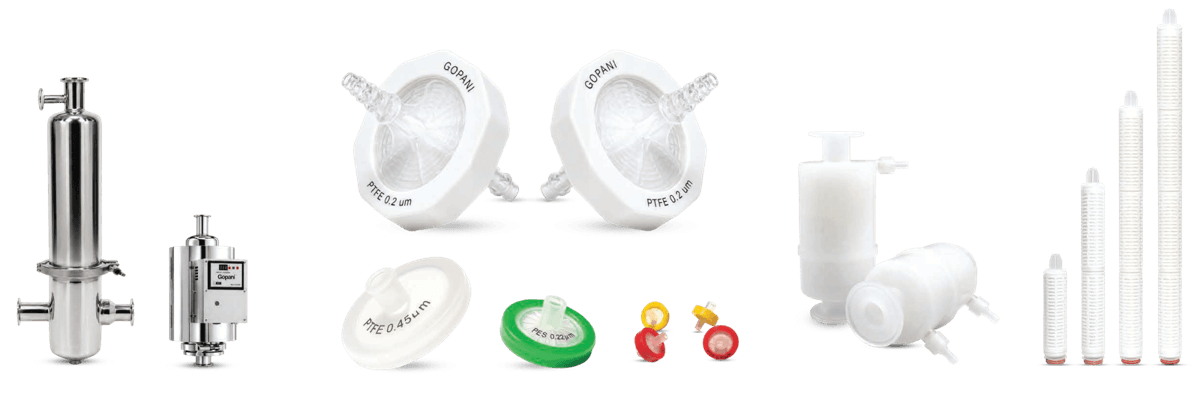
Filters and housings for each point of a UPW system.
Ratings, flush-up data and materials are on each product page and in its catalogue. An application engineer confirms the fit for your system and its specification.
Pretreatment and RO
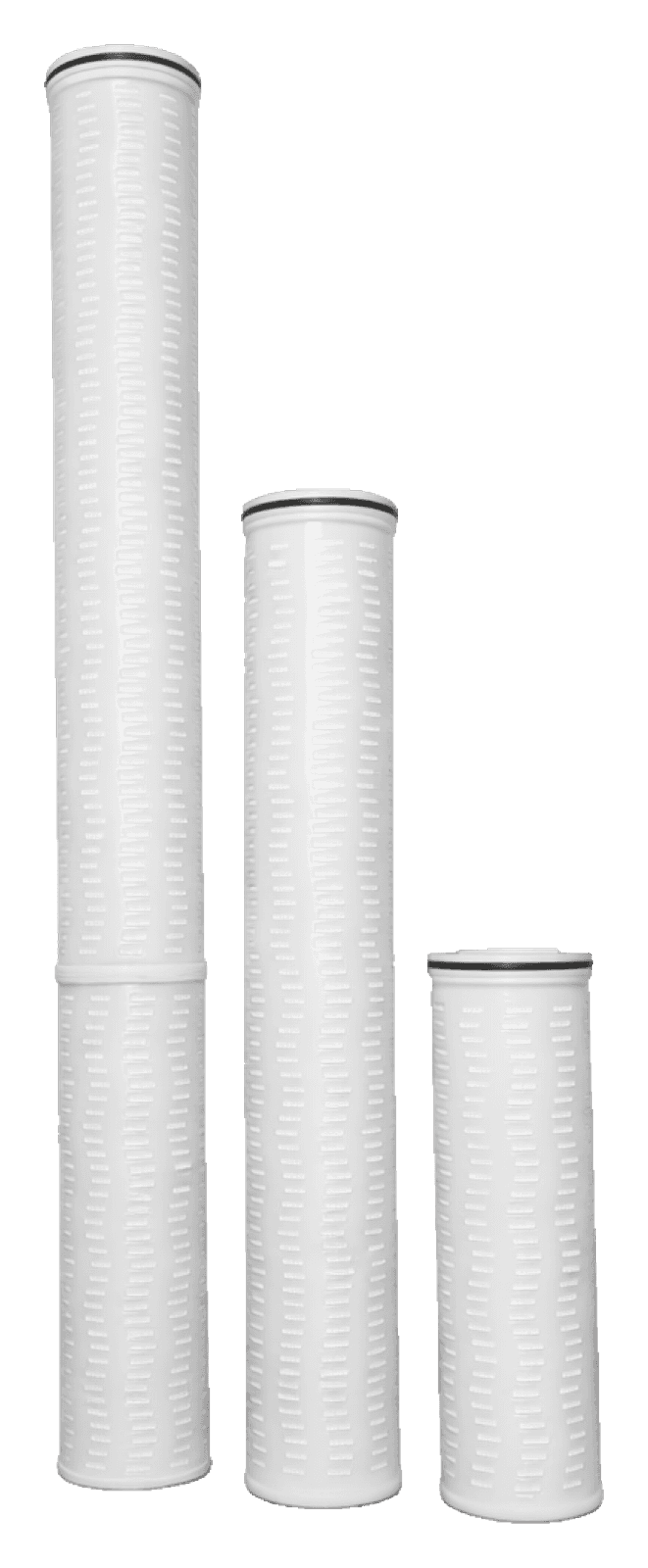
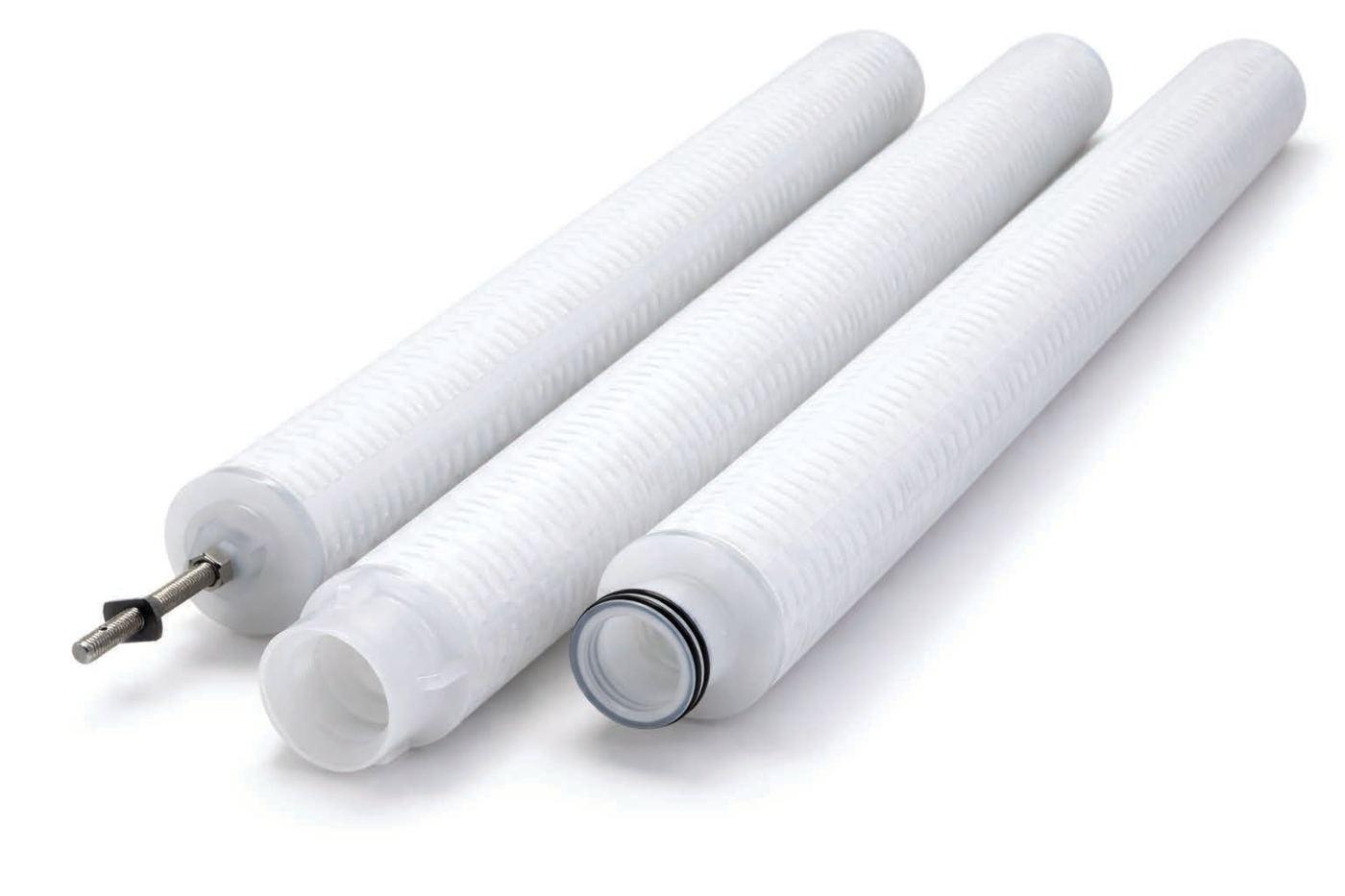
Resin trap, final filter and point of use
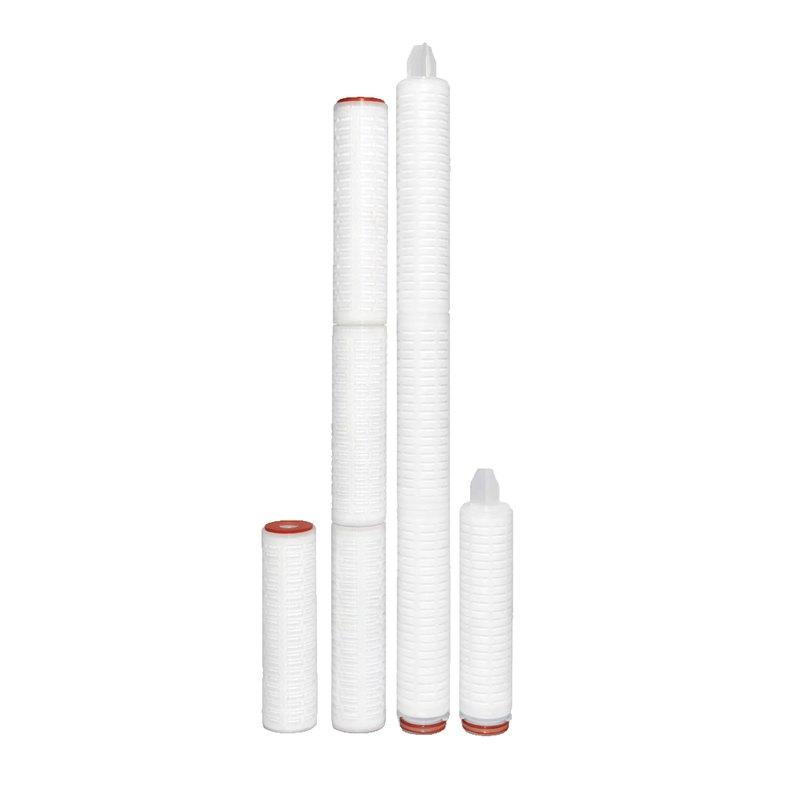
Pleated Filter Cartridges
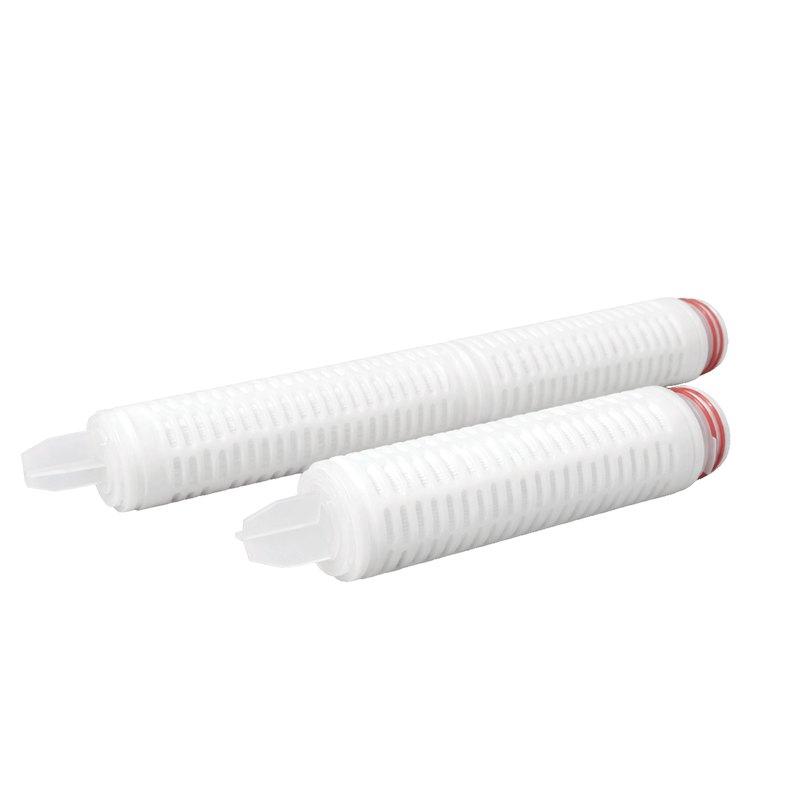
Clarypleat HE
Resin trap after EDI, mixed beds and polishers.
Pleated Filter Cartridges
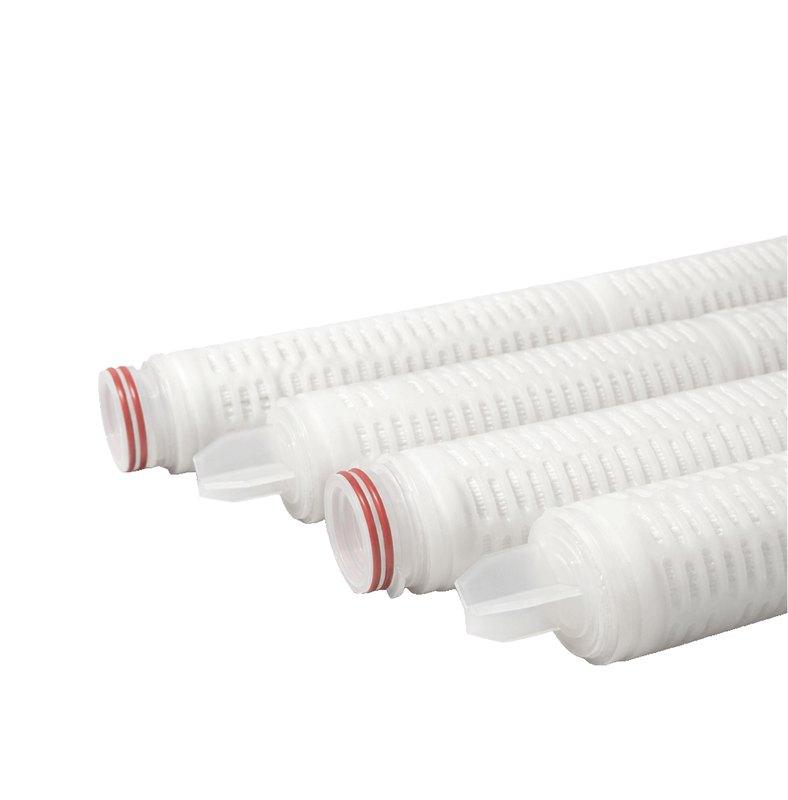
Clarypleat Nylon
Final filter and point of use.
Pleated Filter Cartridges
Clarypleat PES
Final filter after the polishers.
Pleated Filter Cartridges
Kryticalpleat PES
Final filtration of high purity and ultrapure water.
Tank vents, reclaim and housings
Pleated Filter Cartridges
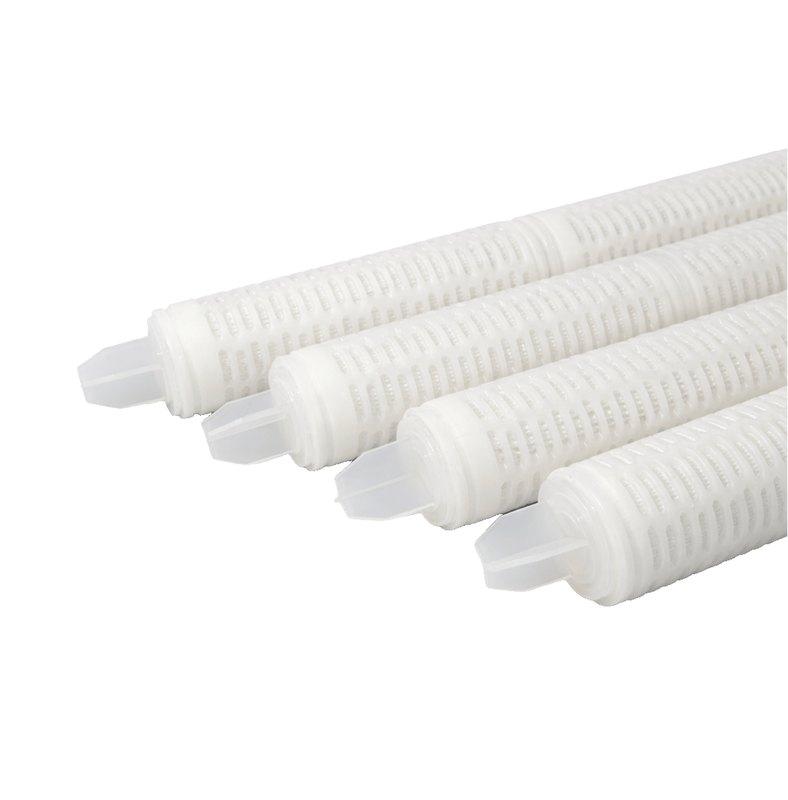
Clarypleat PTFE
Vent filter on each UPW tank.
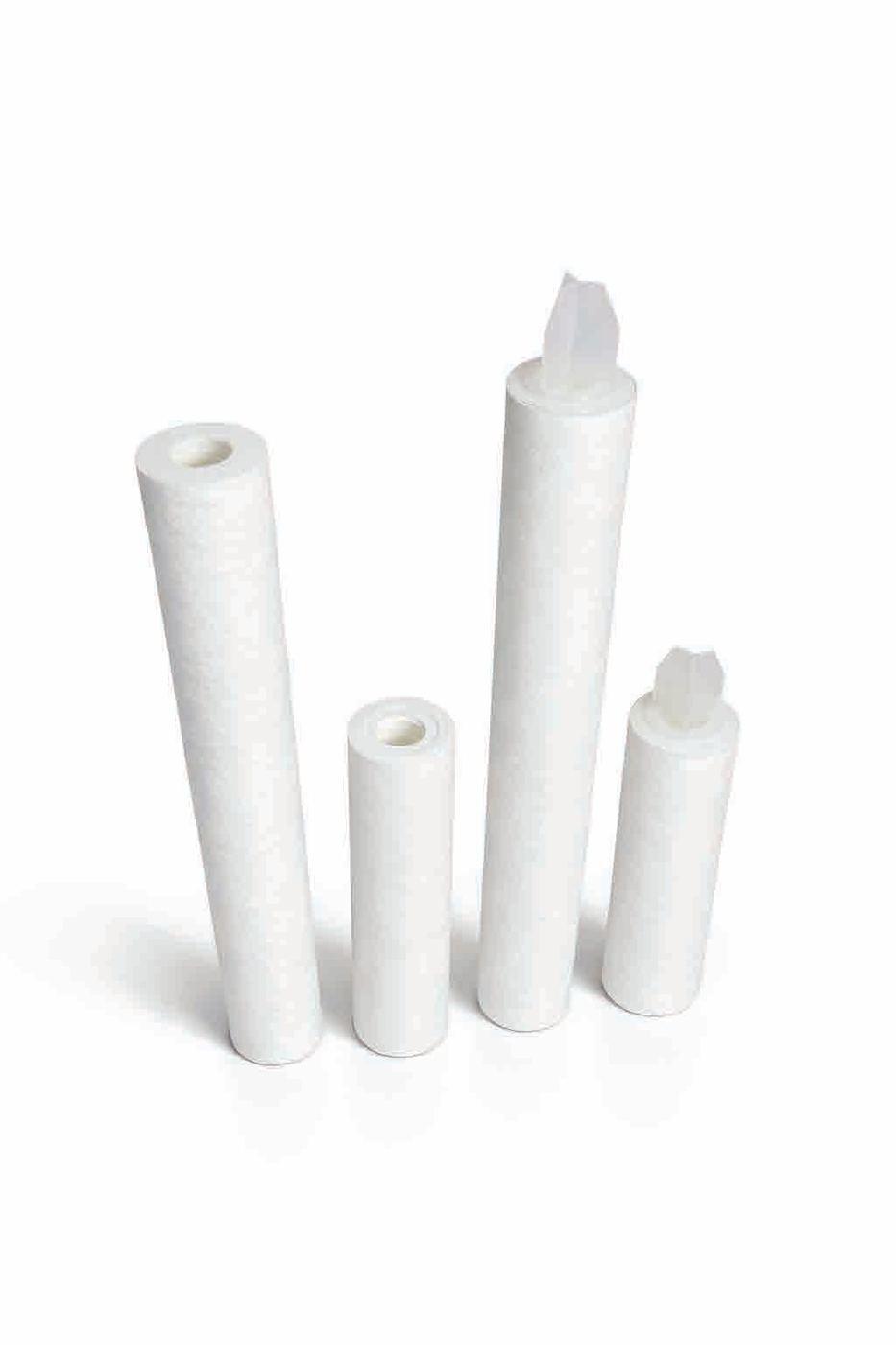
Meltblown Filter Cartridges
RO Protect Ultra
Rinse water returned to the RO feed.
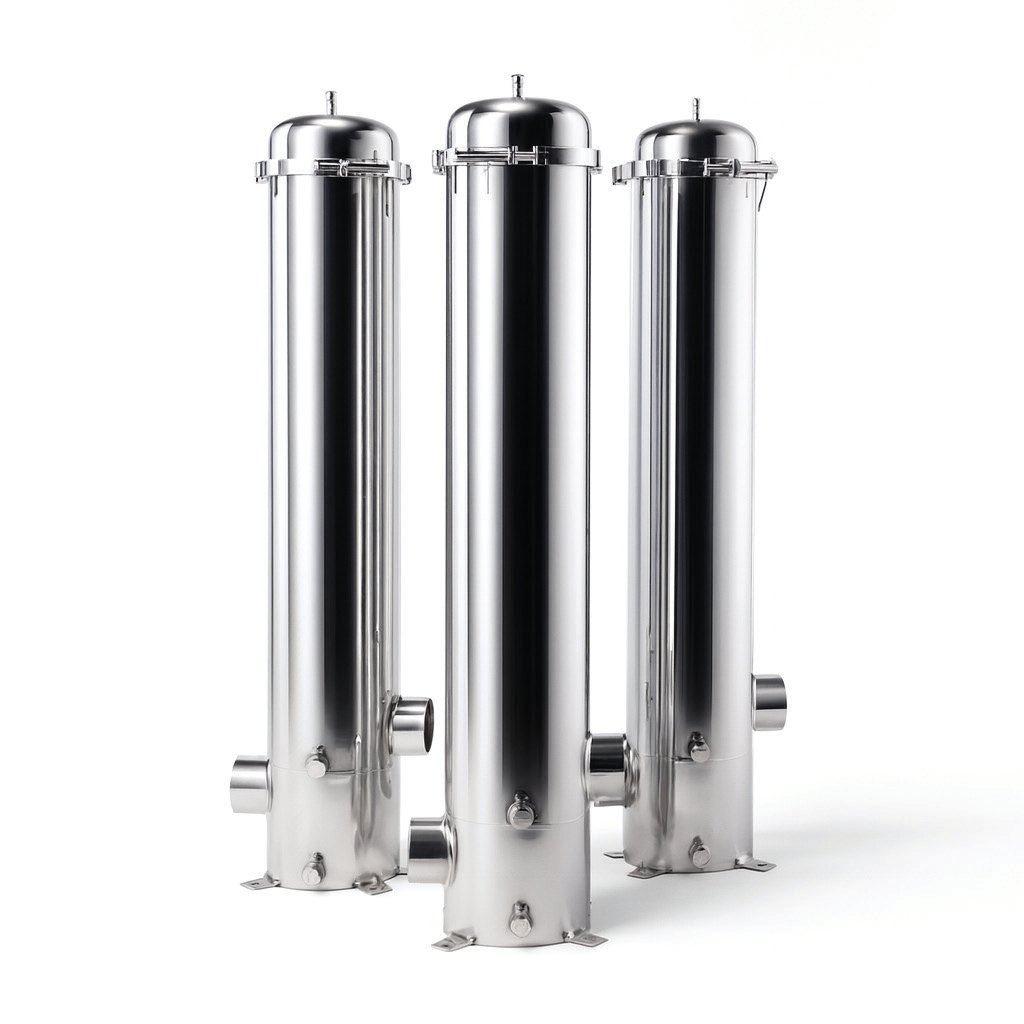
Filter Housings and Systems
Clary-T CF
Stainless steel housings for each point.
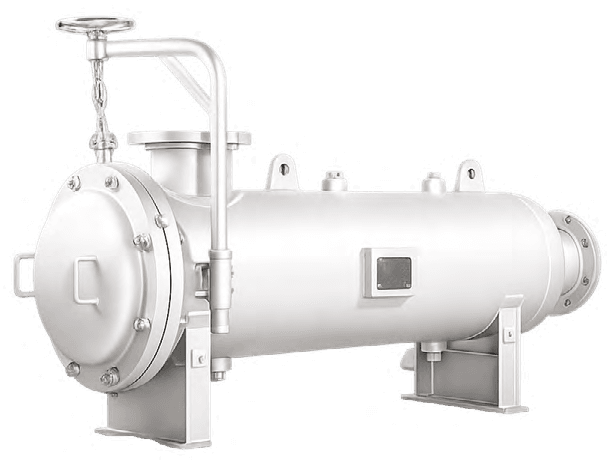
Filter Housings and Systems
Clary-T HF
Housings for high flow filter cartridges.
Related catalogues
Product data and test methods for the filters and housings used in ultrapure water systems, sent by email on request.
- Clary-T SS filter housings2.1 MB · Sep 2026Request
- RO Protect Extreme2.3 MB · Sep 2026Request
- Clarypleat PTFE3.9 MB · Aug 2026Request
- RO Protect High Flow1.5 MB · Aug 2026Request
- Clarypleat PES1.4 MB · Aug 2026Request
- Clarypleat Nylon0.8 MB · Apr 2026Request
- Clarypleat HE0.6 MBRequest
- Kryticalpleat PES1.1 MBRequest
Send us one process stage. Get back the right filter, its documentation and a price.
Tell us the point in the system, the flow, the water specification at the point of use and the filter cartridge and housing you run today. A part number or a photograph is enough. An application engineer replies with the Gopani filter that fits, its documentation and a quotation. EPCs and consultants writing a UPW specification can ask for catalogues and data sheets for the BOQ.
Request a quote- Talk to an application engineer
WhatsApp or call, Monday to Saturday, IST.
Start a conversation