
Application
Vent filtration. Let the vessel breathe, and keep the room out of it.
Every tank that is filled and emptied moves air through its vent, and that air touches the product. A vent filter decides whether the air arrives clean, whether the vessel can breathe at the rate you fill and empty it, and whether what is in the vessel stays in it. Gopani makes vent filters for vessels holding millilitres to tanks of thousands of litres.
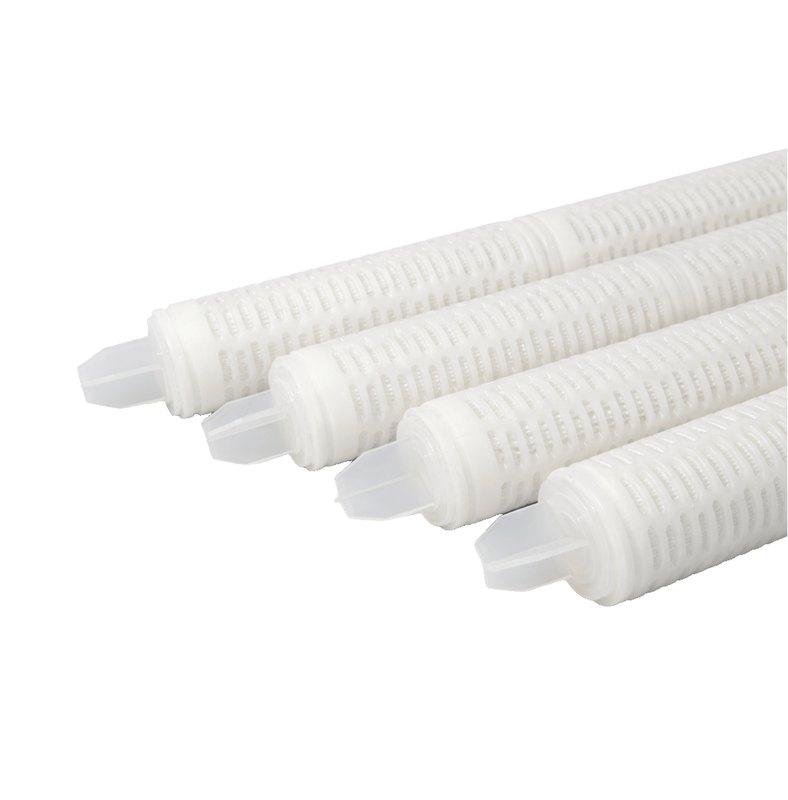
- Membrane
- PTFE
- Formats
- Disc, capsule, filter cartridge, sintered metal
- Housings
- Electropolished, jacketed option
- Integrity test
- Bubble point, diffusion, water intrusion
What is at stake
One filter, three things it protects
The contents
As the vessel is emptied, room air is drawn in over the product. The vent filter holds back airborne particles and microorganisms before they reach WFI, media, buffer or a finished batch.
The vessel
A blocked or wet vent cannot pass air. Pump out against it and the vessel pulls a vacuum; fill against it and pressure builds. Thin-walled tanks are not built for either.
The room and the people in it
Displaced air leaves through the same filter. Aerosols, solvent vapour carried with droplets, and organisms from a fermentor stay on the process side.
How a vent works
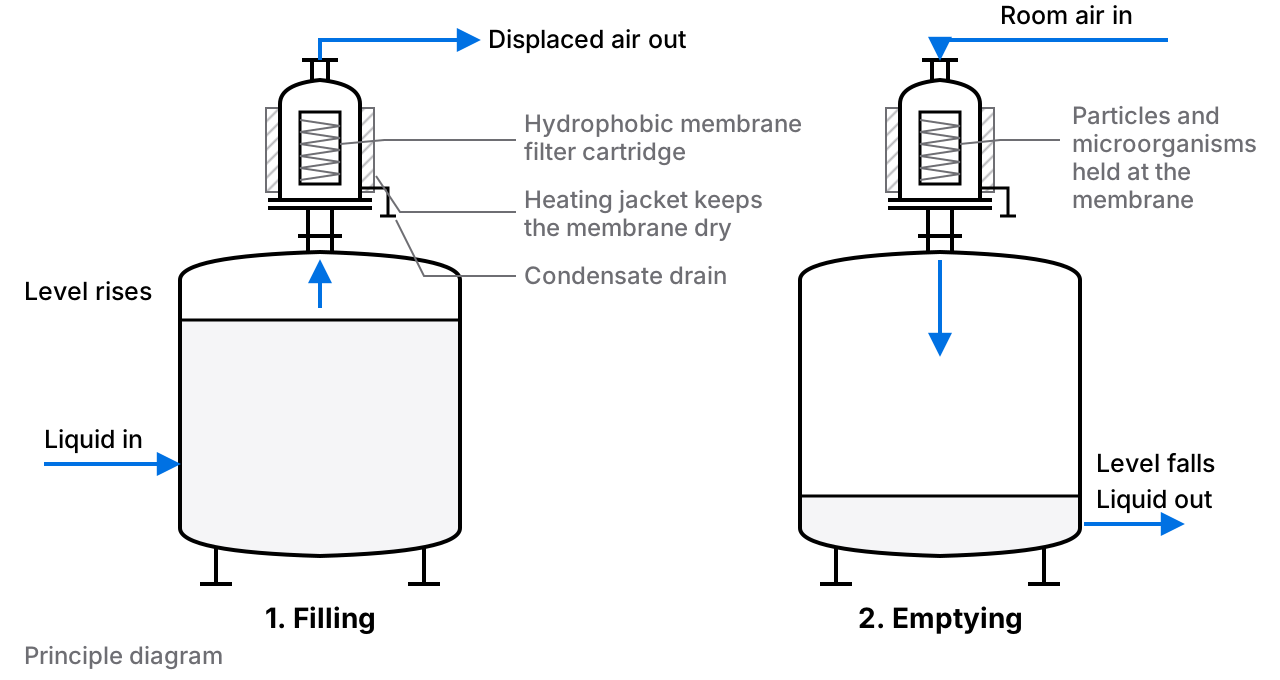
Air out on filling, air in on emptying
01
Filling
The rising level pushes the headspace out through the filter, so the vent holds back what the process gives off.
02
Emptying
The falling level draws room air in through the same filter, which retains what the air carries before it meets the product.
03
Sterilising
The vent is steamed in place or autoclaved with the vessel. Condensate has to drain away, not settle on the membrane.
04
Testing
The filter is integrity tested before use, after sterilisation or after the batch, by the method your validation sets.
A hydrophobic membrane stops water at the pressures a vent sees, but it does not dry itself. Water that condenses on it closes it to air, which is why heat and drainage matter as much as the membrane.
The range
From vessels holding millilitres to tanks of thousands of litres
One membrane, hydrophobic PTFE, in the format that suits the vessel, and sintered metal where a polymer membrane does not suit the duty.
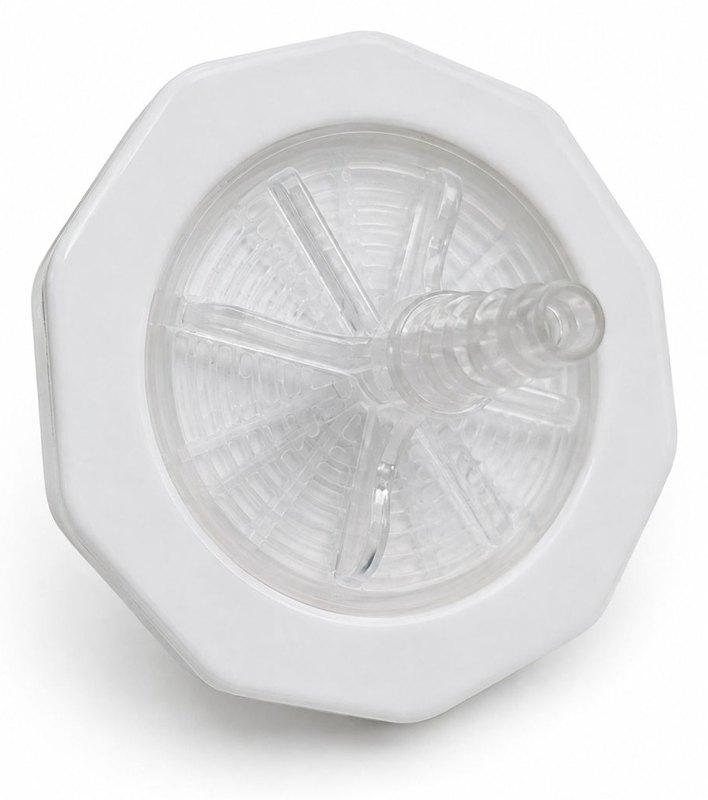
Disc vent filter
Uni.Q PTFE
Hydrophobic PTFE membrane in a disc on a hose barb, for carboys, bottles, small vessels and single-use assemblies.
Explore: Disc vent filter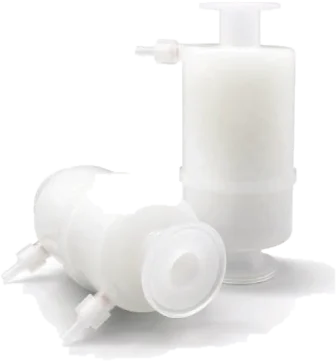
Capsule
Clarypleat PTFE capsule
Hydrophobic PTFE in a polypropylene capsule, for pilot vessels, small tanks and fermentor venting.
Explore: Capsule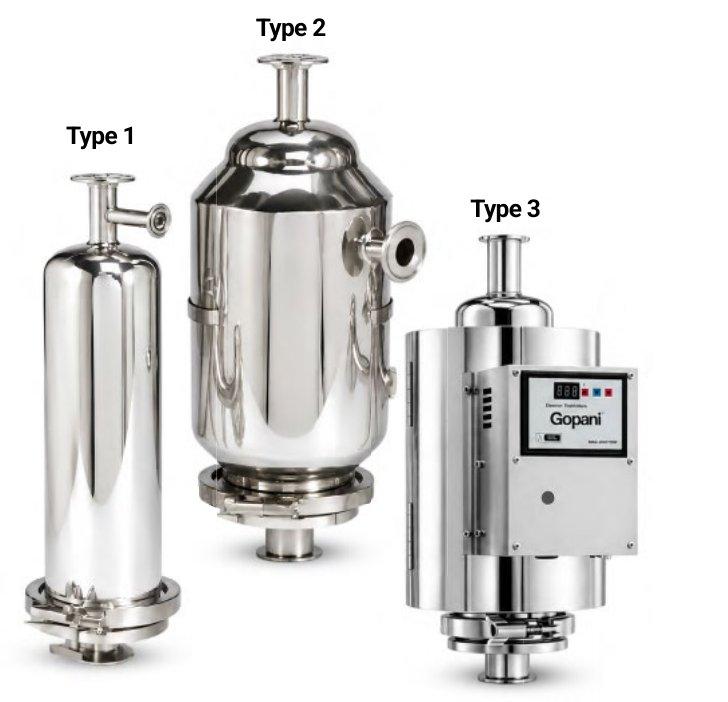
Filter cartridge in a vent housing
Clarypleat PTFE with Clary‑T Vent
Hydrophobic PTFE filter cartridges in electropolished vent housings, standard or jacketed, for process and storage tanks.
Explore: Filter cartridge in a vent housing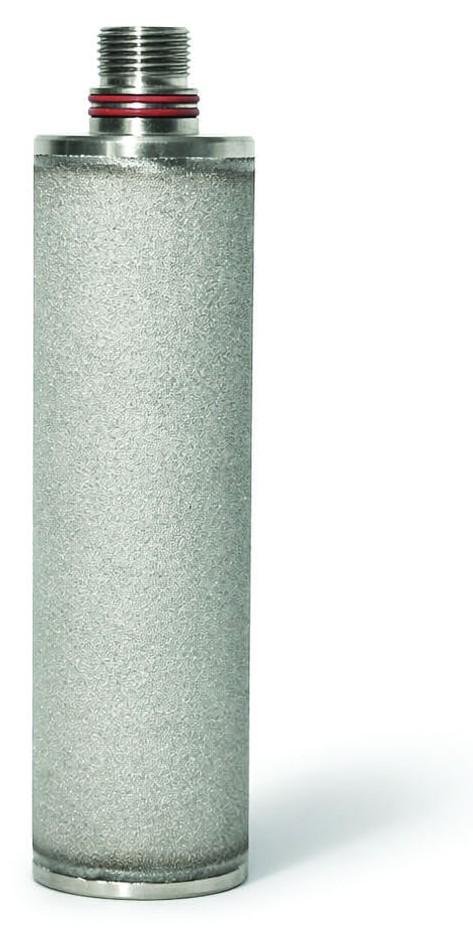
Sintered metal
Clarysynt
Sintered metal filters for vents that run hot, on steamed and sterilised systems, and for industrial environments.
Explore: Sintered metal
Aggressive gases at the vent? Kryticalpleat All Fluoropolymer, with every wetted part in fluoropolymer
Special duties
Tanks that ask more of the vent
Ozonated water tanks in pharma
Ozone keeps the water and the tank sanitised, and some of it reaches the headspace and the vent. Ozone attacks many plastics and elastomers, so the membrane, its support and every seal at the vent have to suit it.
Send the ozone level in the water, the tank volume and the sanitisation cycle.
Enquire: Ozonated water tanks in pharmaHot water and hot WFI tanks
Warm, wet air sits in the headspace all the time. If the membrane cools below the dew point, condensate closes it to air and the tank cannot breathe. A heated or jacketed housing keeps the membrane dry, and the vent is mounted so condensate drains.
Send the water temperature, the tank volume and the fill and draw-off rates.
Enquire: Hot water and hot WFI tanks
Selection
What decides the vent filter
| Air flow at the fill and empty rates | The vent must pass the air the vessel displaces at its fastest fill and fastest pump-out, within the pressure and vacuum the vessel is rated for. The filter area follows from that, not from the vessel volume alone. |
|---|---|
| A hydrophobic membrane | PTFE repels water, so the membrane stays open to air on a humid vessel and does not let liquid through at vent pressures. |
| Heat against condensate | On WFI tanks, fermentors and steamed vessels, a jacketed or heated housing keeps the membrane above the dew point; the vent is mounted so condensate drains. |
| Sterilisation | Steam in place, autoclave or gamma: the format and its materials are chosen for the method and the number of cycles. |
| Integrity testing | Bubble point, diffusion or forward flow, or water intrusion, matched to the format and to where the test is done. |
| Housing and connection | Electropolished, crevice-free housings with sanitary connections on fixed vessels; a hose barb on a carboy or a single-use set. |
Troubleshooting
Common challenges
What each problem looks like on the line, what usually causes it, and the first two things to check.
Emptying the vessel
Likely causes
- The vent cannot pass the air the vessel draws in at the pump-out rate
- The membrane is wet or blinded, so its resistance has risen
- A valve on the vent line is closed or part closed
Check first
- Differential pressure across the vent during draw-down, against the vessel vacuum rating
- Whether the membrane is wet when the filter is taken out
What the right fix depends on
The peak air flow at the fastest empty rate, the vacuum the vessel is rated for, and whether condensate reaches the membrane.
For sizing
Send these details. Get back the format, the filter area and the housing.
Mark anything you do not know as unknown. An application engineer sizes the vent from what you send.
| Vessel | Type, working volume, design pressure and the vacuum it is rated for |
|---|---|
| Fill and empty rates | The fastest of each, in litres per minute or m³/hr, and whether they can happen together with gas blanketing |
| Contents and headspace | Liquid, temperature, foaming, solvent vapour, CO₂ or nitrogen |
| Cleaning and sterilisation | CIP, SIP or autoclave, with temperature, time and cycles a year |
| Integrity testing | Method, where it is done, and your acceptance criteria |
| Connection | Present housing or vessel nozzle, or tubing size for a single-use set |
Send one vessel and its cycle.
The vessel, its fill and empty rates, how it is cleaned and sterilised, and what goes wrong today. An application engineer replies with the vent format, the filter area and the housing.
Request a quote