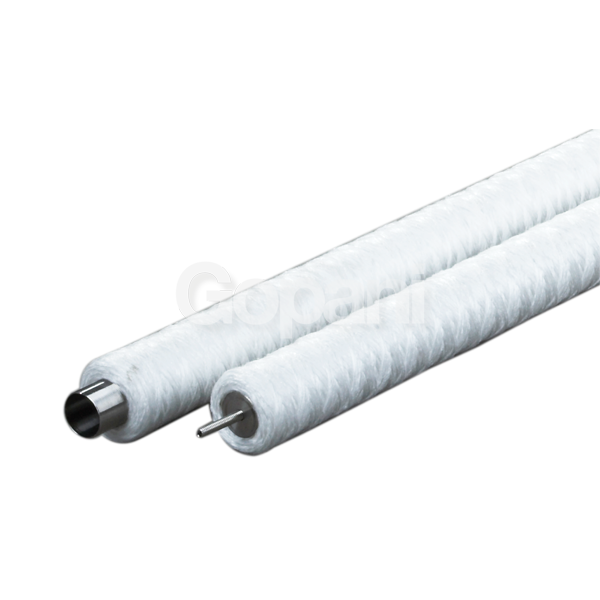
String Wound filter Cartridge with high dirt holding capacity, engineered for superior performance and longer life!

STRING WOUND CARTRIDGE FILTER MANUFACTURER IN INDIA
High-Efficiency Depth Filtration · 0.5–150 Micron · ISO-Certified Manufacturer & Exporter
Gopani Filters Private Limited is a leading string wound cartridge filter manufacturer in India, supplying precision-engineered depth filtration solutions to industrial water treatment plants, RO system builders, electroplating and surface finishing plants, chemical processors, textile dyeing units, power stations, and oil & petrochemical facilities across India and 30+ countries worldwide.
Our string wound filter cartridges deliver true depth filtration, not just surface filtration, trapping particles throughout the full depth of the wound matrix. This gives Gopani string wound filters a significantly higher dirt-holding capacity than comparable melt blown cartridges, longer service life, and lower total cost of operation.
Manufacturer Advantage: Because we manufacture in-house, we offer custom micron ratings, core materials, winding media, and OEM labelling at factory-direct prices with lead times as short as 3–5 working days for standard configurations.
A string wound cartridge filter (also called a wound filter cartridge, thread wound filter, depth filter cartridge, or string filter cartridge) is manufactured by precisely winding yarn, polypropylene (PP), cotton, nylon, polyester, BICO, or glass fibre, around a rigid central core in a diamond-weave pattern using CNC-controlled precision winding machines.
The unique diamond-winding pattern creates a graduated pore structure: larger pores at the outer surface progressively tighten toward the inner core. This graded density is what makes string wound filters true depth filters, particles are captured throughout the media depth, not just at the surface.
Gopani is a fully integrated ‘fibre to filter’ manufacturer. We spin our own yarn in-house before winding, giving us control over fibre denier, twist, and composition that no trading-house supplier can match. This vertical integration is why our cartridges deliver tighter pore-size tolerance across every batch.
Because particles are held throughout the media depth, string wound cartridges hold 3-5x more dirt per unit volume than surface-type filters. This means longer filter life between changeouts, critical for high-flow industrial applications.
| Parameter | Specification / Range |
|---|---|
| Micron Rating | 0.5, 1, 5, 10, 20, 25, 30, 50, 75, 100, 150 µm (custom available) |
| Cartridge Length | 5″, 10″, 20″, 30″, 40″, 50″, 60″, 70″ (125mm, 250mm, 500mm, 750mm, 1000mm; custom lengths available) |
| Outer Diameter | 2.5″ (61mm / 63.5mm) standard; 4.5″ big-blue available |
| Inner Core Diameter | 1″ / 28mm (specify on order; other sizes available) |
| Winding Media | Polypropylene (PP), Cotton, Glass Fibre, Nylon, Polyester, BICO (Bicomponent) |
| Core Material | Polypropylene (standard), SS304, SS316, ABS |
| End Cap / Connector | Polypropylene (standard), SS304, SS316; DOE (double open end) and SOE (single open end) available; flat, fin, and spear configurations |
| Max. Operating Temp. | 80°C (PP/PP core); 120°C (Cotton/SS core); 121°C (Polyester/SS core); 130°C (BICO); 140°C (Nylon/SS core); 350°C (Glass Fibre/SS core) |
| Change-out Differential Pressure | 0.25 MPa (2.5 bar; 36.25 psid) at 21°C; replace cartridge when this pressure drop is reached |
| Initial Pressure Drop | 0.1–0.3 bar at standard flow rate (contact us for your specific fluid and housing configuration) |
| Certifications | ISO 9001:2015, ISO 14001, ISO 45001 (IMS); RoHS-compliant; FDA-grade PP available; NSF 42 certificate available on request |
| Custom OEM | Yes: Sizes, micron, label, packaging, core type, pallet quantities; Non-foaming PP grade available on request |
Request a Sample or Get a Quote: Call / WhatsApp +91-706 901 8049 | Email: sales@gopani.com
One of the most common questions we hear from buyers is: ‘Should I choose a string wound or melt blown filter cartridge?’ The right answer depends on your application, fluid type, contamination profile, and budget. Here is a side-by-side comparison based on our manufacturing experience and real-world application data:
| Feature / Criteria | String Wound Cartridge | Melt Blown Cartridge |
|---|---|---|
| Filtration Mechanism | True depth filtration (throughout media) | Depth filtration (gradient density) |
| Dirt-Holding Capacity | Very High (3–5× more than surface filters) | High |
| Micron Range | 0.5–150 µm | 0.5–50 µm |
| Media Options | PP, Cotton, Nylon, Polyester, BICO, Glass Fibre | Polypropylene only |
| Chemical Resistance | Excellent (PP and glass fibre), Good (cotton, nylon) | Good (PP only) |
| Temperature Resistance | 80°C (PP); 120°C (Cotton/SS); 130°C (BICO); 140°C (Nylon/SS); 350°C (Glass Fibre/SS) | Up to 80°C (PP) |
| Media Migration | Low (yarn is securely wound) | Very Low (thermally bonded) |
| Fibre Shedding Risk | Moderate (use PP for sensitive apps) | Very Low |
| Best For | High-dirt-load applications, RO pre-filtration, industrial water, electroplating baths, chemical processing, textiles, oils | High-purity water, critical electronics process fluids, fine chemical polishing |
| Cost (per cartridge) | Lower (ideal for high-volume replacements) | Slightly higher |
| Gopani Availability | Full range (all microns, all lengths) | Full range available |
Bottom Line: For most Indian industrial water treatment, RO pre-filtration, electroplating, chemical processing, and power plant applications, string wound cartridges deliver the best cost-per-litre-filtered performance with high dirt-holding capacity. Where absolute fibre migration control is required as a final polishing step, pairing a string wound pre-filter with a melt blown final filter is the industry-standard approach.
All Gopani string wound filter cartridges are manufactured under the Clarywound brand: seven purpose-engineered variants covering every application from standard industrial water treatment to high-temperature chemical processing and power plant condensate polishing. Every Clarywound cartridge is CNC precision-wound (no manual winding), contains no resin binders, lubricants, antistatic agents, or release agents, and is manufactured from FDA-grade materials.
Manufacturing philosophy: Right Yarn. Right Winding. Right Quality. Right Testing. Right Filtration. Every Clarywound cartridge starts with yarn spun in-house at Gopani’s integrated fibre facility. We do not buy yarn from the market. This ‘fibre to filter’ control is the foundation of consistent quality across batches.
The flagship Clarywound variant, designed where filtration performance cannot be compromised. Clarywound Extreme uses Gopani’s precision CNC winding technology to create a graded-density matrix that maximises particle capture throughout the full depth of the cartridge, not just at the surface. Available in PP, Cotton, Nylon, Polyester, BICO, and Glass Fibre yarn options; PP or SS core.
Clarywound 3X is Gopani’s patented multi-layer wound cartridge. Three distinct yarn densities are wound concentrically, creating defined pre-filter, intermediate, and final filtration zones within a single cartridge. This delivers significantly higher dirt-holding capacity versus single-density wound cartridges and extends service intervals in high-contamination duty cycles.
Where performance requirements are standard and cost per cartridge is the primary decision criterion, Clarywound Ultra delivers reliable depth filtration at the most competitive price point. Wound on Gopani’s CNC machines with the same quality yarn, the same manufacturing DNA as Clarywound Extreme, optimised for high-volume industrial procurement.
When process temperatures exceed the limits of PP or polyester, or when the fluid chemistry would degrade organic yarns, Clarywound GF uses borosilicate glass fibre yarn on a stainless steel core. The result is a cartridge that remains structurally sound at temperatures up to 350°C and maintains chemical resistance across a wide range of acids, alkalis, and organic solvents.
Clarywound BICO uses bicomponent (BICO) fibre, a specialised fibre with a polyester base construction, that achieves a higher rated temperature than standard PP while maintaining excellent chemical resistance. Rated to 130°C, BICO bridges the gap between PP (80°C) and glass fibre (350°C) for process streams in the 80-130°C range.
Clarywound NYLON uses nylon yarn wound around a stainless steel core, offering a distinct chemical resistance profile from PP, particularly suited to applications where PP is incompatible but glass fibre would be over-specified. Rated to 140°C with SS core.
Clarywound CPU is engineered specifically for condensate polishing in power generation. In thermal and combined-cycle power plants, steam condensate must be recovered and polished to remove corrosion products (iron oxides, copper fines) before return to the boiler. Condensate polishing protects ion exchange resin beds and boiler tubes, directly impacting plant availability and maintenance cost.
Manufacturing method note: All Clarywound cartridges are CNC precision-wound on computer-controlled winding machines maintaining exact yarn tension and winding angle. This is the manufacturing method, not a separate product variant; it is the foundation of consistent pore-size control across the entire Clarywound range.
String wound depth filter cartridges excel wherever fluids carry a high dissolved or suspended load and a cost-effective, high-capacity pre-filter is needed. The applications below represent core end-use markets validated by leading global manufacturers including Parker, Pall, Global Filter, ABSFil, and Serfilco, aligned with Gopani’s own installed-base experience across India and export markets.
| Industry / Sector | Specific Applications | Typical Micron Rating | Recommended Clarywound Grade |
|---|---|---|---|
| Industrial Water Treatment & RO Systems | Pre-filtration before RO membranes (SDI reduction); DM plant pre-filter; process water clarification; borewell/groundwater sediment removal; boiler feed water pre-treatment | 5 µm or 10 µm standard; 1 µm for tight SDI requirements | Clarywound Ultra, Clarywound Extreme |
| Power Plants & Cooling Systems | Condensate Polishing Unit (CPU) pre-filter; boiler condensate recovery; steam condensate polishing; cooling tower water filtration; chilled water circuit polishing; demineralisation (DM) plant pre-filter; condenser cooling water treatment | 1–10 µm (CPU duty); 5–20 µm (cooling water) | Clarywound CPU, Clarywound Extreme |
| Desalination (SWRO / BWRO) | Seawater and brackish water pre-filtration before RO membranes; SDI reduction for SWRO trains; media filter effluent polishing; intake water clarification for coastal plants | 5–20 µm (pre-RO); 1–5 µm (polishing stage) | Clarywound Extreme, Clarywound Ultra |
| Chemical Processing | Acids, bases, solvents clarification; catalyst fines removal; chemical raw material pre-filtration; amine and glycol processing; resin and polymer slurry pre-filter (PP or glass fibre grades) | 1–50 µm (PP or glass fibre per chemical compatibility) | Clarywound GF, Clarywound Extreme |
| Electroplating & Surface Treatment | Plating bath filtration (nickel, copper, zinc, chrome); anodising bath filtration; electroless plating solution polishing; rinse water pre-filter; PCB manufacturing wash solutions; trivalent and hexavalent chrome processes; plating on plastics | 1–10 µm (fine filtration critical for surface finish quality) | Clarywound Extreme |
| Petrochemicals, Oils & Lubricants | Lubricating oil filtration; fuel pre-filtration; amine and glycol process streams; hydraulic fluid pre-filter; edible oil clarification; resins and waxes processing | 5–50 µm (glass fibre for high-temp oil) | Clarywound GF, Clarywound Extreme |
| Textile & Dyeing Industry | Dye-bath water pre-filtration; process water for dyeing and printing; cooling water for textile machinery; wash water recirculation; yarn & fabric sizing water treatment | 5–25 µm | Clarywound Ultra, Clarywound Extreme |
| Paints, Inks & Coatings | Pigment particle removal before filling; solvent and carrier clarification; water-based paint process water; ink filtration before packaging; coating chemicals pre-filter | 5–50 µm (match pigment particle size) | Clarywound Extreme |
| Electronics & PCB Manufacturing | Process chemical filtration; etching and stripping bath pre-filter; DI water pre-filter; semiconductor wafer rinse water; wash solution polishing; solar cell and connector manufacturing process fluids | 1–5 µm (critical for surface cleanliness) | Clarywound Extreme |
| Waste Water & Effluent Treatment | Industrial effluent pre-filter before discharge or recycle; cooling tower blowdown; RO reject polishing; process condensate recovery; chemical plant effluent clarification | 10–100 µm | Clarywound 3X, Clarywound Ultra |
| Machine Shop & Industrial Fluids | Cutting fluid and coolant filtration; hydraulic system pre-filter; metalworking fluid clarification; wash water in metal fabrication and CNC machining | 10–50 µm | Clarywound Ultra, Clarywound Extreme |
Industry note: For electroplating and surface finishing applications, filter cartridge media cleanliness and zero extractables are critical. Gopani supplies USP-grade PP wound cartridges for plating bath use: specify ‘plating grade’ when ordering. Cotton wound cartridges should not be used in chrome or acid plating baths.
Selecting the correct string wound cartridge involves five key parameters. Getting even one wrong can result in premature filter blinding, contamination bypass, or unnecessary filter changeout costs. Here is Gopani’s selection guide:
Step 1: Determine Your Target Particle Size: What is the smallest particle size you need to remove? For RO plant pre-filtration, 5 µm or 10 µm is standard (removes silt, sand, rust). For electroplating bath filtration, 1–5 µm is typical to maintain surface finish quality. For chemical process streams, match the micron to the contaminant particle size in your fluid analysis. If in doubt, start with 5 µm and measure your pressure drop cycle.
Step 2: Know Your Flow Rate: Flow rate determines how many cartridges you need in a housing. A single 10″ cartridge handles approximately 1 m³/hr (around 17 LPM) at low pressure drop in clean water service. For 6 m³/hr (100 LPM), you need 6 × 10″ cartridges, or 3 × 20″ cartridges in a multi-round housing. For 12 m³/hr, use a 7 × 20″ housing. Contact us to size your system.
Step 3: Check Your Fluid Chemistry: If your fluid contains acids, alkalis, or solvents above 20% concentration, use PP or glass fibre. For mild applications or food contact, cotton may be used. Never use cotton with chlorinated solvents or strong oxidising agents.
Step 4: Confirm Temperature: PP cartridges (Clarywound Extreme/Ultra) are rated to 80°C. For 80–130°C, specify Clarywound BICO (polyester base, 130°C). For 130–140°C, use Clarywound NYLON (140°C with SS core). For extreme temperatures above 140°C, specify Clarywound GF glass fibre (rated to 350°C). Always use the correct grade as exceeding the rated temperature will cause cartridge deformation and bypass.
Step 5: Choose the Correct Length and Core: Standard housings accept 10″ or 20″ cartridges. Multi-round housings accept 3, 5, 7, or 10 cartridges in parallel. Specify your housing brand and size when ordering and Gopani will supply the correct fit, gasket type, and end-cap configuration.
Not sure which cartridge is right for your application? Share your water quality report, flow rate, and housing details with our technical team and we will recommend the correct filter and housing configuration, free of charge.
Get Free Filter Selection Advice: WhatsApp / Call +91-706 901 8049 or Email sales@gopani.com
| Gopani Advantage | What It Means For You |
|---|---|
| Direct Manufacturer | No middlemen, no trader markup. You buy from the factory. This means 15–25% lower cost vs. trading house prices and ability to customise specifications. |
| 30+ Years Experience | Gopani has been manufacturing filtration systems since 1993. Our engineers have solved filtration challenges in 30+ countries and across every major industrial sector. |
| ISO 9001:2015 Certified | Every batch is manufactured to a documented quality system. Pore-size testing, pressure drop testing, and burst-strength testing are standard for export orders. |
| Full Micron Range | 0.5 µm to 150 µm in a single factory. No need to source different grades from different suppliers. Consistent quality across the entire range. |
| Custom OEM Capability | Private labelling, custom packaging, custom colours, non-standard lengths and core sizes. Minimum order quantities are negotiable for established partners. |
| Fast Lead Times | Standard configurations: 3–5 working days. Custom configurations: 7–10 working days. We maintain buffer stock of high-runner grades for emergency orders. |
| Export Expertise | Shipping to USA, Europe, Middle East, Africa, Southeast Asia, and Australia. We handle export documentation, packaging for sea/air freight, and country-specific labelling requirements. |
| Complete Filter Systems | We do not just supply cartridges. Gopani manufactures filter housings, vessels, skids, and complete filter systems. One supplier for cartridges + housings = fewer procurement headaches. |
Gopani’s string wound cartridge filters are manufactured under a certified Integrated Management System (IMS) covering ISO 9001:2015 (Quality), ISO 14001 (Environment), and ISO 45001 (Occupational Health and Safety). We maintain detailed batch records, raw material test certificates, and outgoing inspection records for every production run.
For government tenders, institutional procurement, or export orders requiring specific certifications or test reports, contact our quality team at quality@gopani.com. We will provide the required documentation package.
Gopani is an established exporter of string wound cartridge filters to buyers in the USA, UK, Germany, Netherlands, UAE, Saudi Arabia, Kenya, South Africa, Thailand, Vietnam, Singapore, and Australia.
For international buyers, Gopani offers:
Competitive Advantage for International Buyers: India-manufactured string wound filters from an ISO-certified direct manufacturer provide 30–50% cost savings compared to equivalent products sourced from US/European distributors, with comparable or superior quality. Lead times to port: 7–14 days for standard configurations.
International Enquiries: sales@gopani.com | WhatsApp +91-706 901 8049
A string wound filter is made by winding yarn (PP, cotton, glass fibre, nylon, polyester, or BICO) around a core in a precise CNC-controlled diamond pattern. A spun or melt blown cartridge is made by extruding thermoplastic fibres onto a core. The key difference: string wound has higher dirt-holding capacity and excels in high-contamination, high-flow duty cycles (water treatment, electroplating, chemicals), while melt blown provides a more uniform pore structure for lower fibre migration. For most industrial applications, string wound is the preferred and more economical choice. See our full comparison table above.
For RO plant pre-filtration, 5 µm is the standard. For high SDI feed water, use a 10 µm stage before the 5 µm stage. For electroplating bath filtration (nickel, copper, chrome), 1–5 µm is recommended to protect surface finish quality. For chemical processing streams (acids, solvents, glycol), match micron to the contaminant size, typically 5–25 µm. For power plant cooling water or DM plant pre-filters, 5–10 µm works well. For machine shop coolants, 10–25 µm is typical.
Service life depends on the contamination level in the feed water, the micron rating, and the maximum allowable pressure drop. Typical service life ranges from 2 weeks (very high turbidity borewell water) to 6 months (relatively clean municipal feed water). The standard replacement trigger is when pressure drop across the housing reaches 0.5–0.7 bar above clean pressure drop.
Generally, no. String wound cartridges are designed as single-use disposable elements. Back-flushing or cleaning typically does not restore the original pressure drop curve and can dislodge trapped particles back into the process stream. In high-cost applications, some users acid-wash or bleach-soak cotton wound cartridges, but this is not recommended by Gopani for critical applications.
For standard off-the-shelf configurations (e.g., 10″ × 1µm PP, 20″ × 5µm PP), there is no minimum order; we supply from single cartridges for replacement needs up to full container loads for industrial buyers. For custom specifications (non-standard length, special core, OEM labelling), the minimum order is typically 500–1000 pieces depending on the configuration. Contact our sales team for a specific quote.
Yes. Gopani string wound cartridges are manufactured to ANSI/NSF standard outer diameter and length dimensions and fit all standard DOE (double open end) and SOE (single open end) housings from any manufacturer, including Pentek, Harmsco, 3M, Parker, Filtraflo, and Indian-made housings. Please specify your housing model when ordering to ensure the correct end-cap configuration.
Yes. Gopani manufactures a complete range of filter housings in PP, stainless steel (SS304/SS316), and FRP: single-round, multi-round, and jumbo big-blue configurations. Buying cartridges and housings together from a single manufacturer ensures dimensional compatibility, reduces procurement complexity, and gives you a single point of accountability.
We offer sample packs (typically 5–10 cartridges) for qualified buyers conducting product evaluation. Please contact sales@gopani.com with your application details, required micron, length, and current supplier information. We will arrange a sample shipment within 2–3 working days.
The right Clarywound variant depends on your fluid temperature, chemistry, and performance requirement. Clarywound Ultra covers standard industrial water and general process water up to 80°C. Clarywound Extreme is the choice when consistent quality and tighter pore control matter. Clarywound BICO handles temperatures up to 130°C with polyester base chemistry. Clarywound NYLON is selected where nylon compatibility is needed up to 140°C. Clarywound GF (glass fibre) covers extreme temperatures to 350°C and aggressive chemical duty. Clarywound 3X delivers extended service life in high-contamination applications. Clarywound CPU is the dedicated power plant condensate polishing grade. Share your fluid details, temperature, and flow requirements and our technical team will confirm the right variant.
BICO stands for bicomponent fibre, a specialised yarn with a polyester base construction that achieves higher thermal stability than standard PP yarn. Clarywound BICO is rated to 130°C, bridging the gap between PP (80°C limit) and glass fibre (350°C) for process streams in the 80-130°C range. The polyester base gives excellent chemical resistance and structural integrity at elevated temperatures. BICO is commonly specified for hot process water, elevated-temperature plating solutions, and steam condensate applications.
Gopani is a fully integrated ‘fibre to filter’ manufacturer. We spin our own PP yarn in-house at our Ahmedabad facility before the winding process begins. This is a significant distinction from trading houses or assembly-only manufacturers who source yarn externally. In-house yarn production means we control the fibre denier, tensile strength, and chemical purity from raw material to finished cartridge. This is how we maintain consistent filtration performance across production batches and why Gopani cartridges meet OEM quality standards for export markets in Europe, North America, and the Middle East.
Non-foaming PP grade is specified when the filter cartridge is used in chemical dosing systems, surfactant-containing process streams, or any application where standard PP compounds can contribute to foaming in the downstream process. Standard PP compounds contain minor processing additives that, in some surfactant-rich fluids, can act as nucleation sites for foam. Non-foaming PP grade uses a specially compounded resin with these additives removed. It is available across the Clarywound range on request: specify ‘non-foaming PP grade’ when ordering or on your purchase order.
Talk to our technical team for a free filter selection consultation. We supply from single-cartridge replacement orders to full industrial contract volumes, with lead times as short as 3–5 working days for standard grades.
| How to Reach Us | For |
|---|---|
| Call / WhatsApp: +91-706 901 8049 | Quotes, samples, urgent orders, and technical filter selection questions |
| Email: sales@gopani.com | General enquiries, bulk orders, export quotes, and OEM partnerships |
| Website: www.gopani.com | Full product catalogue — filter cartridges, housings, bag filters, RO membranes, and complete filter systems |
ISO 9001:2015 Certified Manufacturer · 30+ Years Manufacturing Experience · Direct Factory Pricing · Exports to 30+ Countries

Gopani's flagship PP string wound filter cartridge , precision CNC-wound for graded depth filtration from 0.5...
It takes a state-of-the-art manufacturing facility and world’s finest yarn to craft products like Clarywound.

Clarywound GF is Gopani's specialty glass fiber (glass fibre) wound filter cartridge, engineered for high-temperature and aggre...
Wound cartridge filters produced from glass fibre, meant for aggressive chemicals and high temperature.
String wound cartridge filter with three times more power
3X Dirt Holding Capacity, 3X Filter Life, 3X Savings , 100% Consistent Efficiency
Gopani's Clarywound Ultra is a reliable PP wound filter cartridge for standard industrial fil...
Value For Money String Wound Cartridges.
Designed for condensate polishing units in power plants
Wound cartridge filters specifically designed for condensate polishing units of power plants.

Designed for Viscous Fluids and Operating Temperature Upto 120°C
Designed for Viscous Fluids and Operating Temperature Upto 120°C

High dirt holding capacity string wound cartridge filters with superior quality cotton media
9.75”, 10”, 20”, 30”, 40”, 50”, 60”, 70” in standard and jumbo sizes.
Polypropylene, Glass Filled Poly Propylene, Stainless Steel, Tinned Steel
Polypropylene, Cotton, Glass Fibre
Gopani has a state-of-the-art manufacturing facility. We have a team of filtration experts and equipment engineers who use unique CNC machines and customize them for a controlled manufacturing process. We have a thorough quality check process for all the products, whether manufactured in-house or sourced from vendors. This way we ensure that any product that moves out of our facility is of the best quality.
Gopani manufactures the best quality cartridge core, that has higher structural integrity than regular the string wound cartridge cores. The Clarywound core does not bend or buckle and provides support to the filter medium to retain the weave density and keep gradient structure intact for a long time.
Regular string wound cartridges often face problems like loosening of the weave, bending of the core and seeping of micro fibres through the filter contaminating the filtered product. The Clarywound on the other hand, has a structurally well build support core. The yarn is also tightly wound using honey comb weave on CNC machines, this means that it does not budge or loosen when it is inserted into the housing or exposed to high flows.